
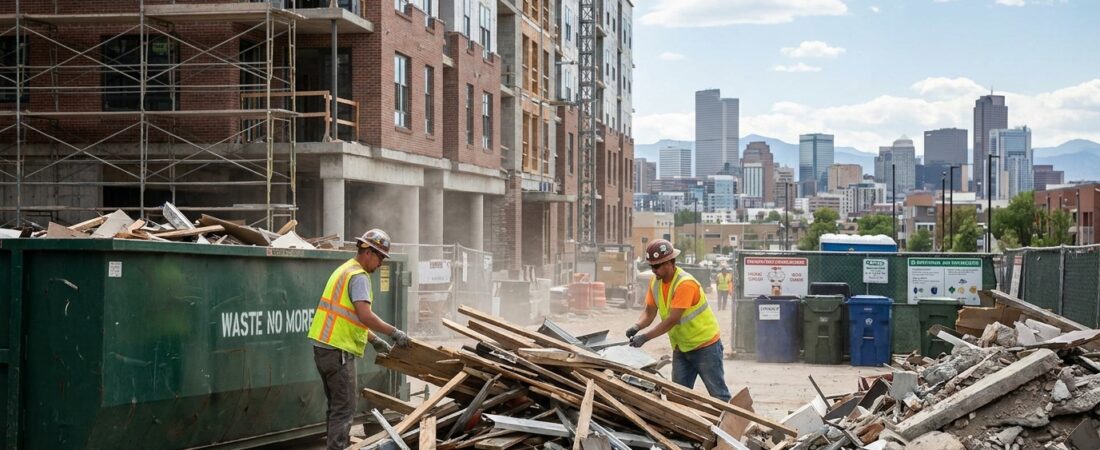
Denver currently diverts less than 30% of its solid waste from landfills, prompting sweeping legislative changes across the city. To address this environmental hurdle, Denver’s Universal Recycling and Composting Ordinance (URCO)—formerly known as Waste No More—was approved by nearly 70% of voters in 2022 and officially takes effect on September 1, 2026. For contractors, project managers, and property developers aiming to secure permits smoothly, understanding these updated rules is no longer optional. Navigating the city’s construction and demolition mandates requires careful pre-planning, dedicated waste streams, and meticulous tracking to ensure compliance before ground is ever broken.
Verify Project Thresholds Early to Determine Mandate Applicability
Knowing exact project square-footage triggers prevents unexpected administrative bottlenecks and ensures compliance planning starts at the right time. When you measure project specifications against city thresholds, you can quickly determine whether your job falls under the direct purview of the ordinance. According to Blue Bear Waste guidance, new construction and demolition projects over 500 square feet, as well as interior renovations, tenant finishes, and remodels over 2,500 square feet, are explicitly bound by the new rules.
Auditing existing architectural plans during preliminary design phases requires a careful, room-by-room assessment of the scope of work. Project managers should review architectural blueprints alongside structural engineering documents to calculate the exact gross square footage before submitting any documentation to the city. If a commercial tenant finish or residential remodel pushes past the 2,500-square-foot mark, the design team must immediately shift focus toward incorporating mandatory material diversion strategies into the early workflow. Catching these dimensions early prevents costly revisions later in the pre-development cycle.
Draft and Submit Your Waste Diversion Plan Before Applying for Permits
Under updated rules adopted by the Denver City Council in September 2025, a recycling and reuse plan must be submitted as part of the permit process and approved before a permit can be issued. Compiling material estimates, identification of recoverable building components, and designated diversion methods prior to initial permit submission helps avoid stalling ground-breaking. As Waste Management notes, all construction and demolition projects in Denver must reuse or recycle recoverable building materials and submit this formal recycling and reuse plan to confirm compliance prior to obtaining a construction or demolition permit.
The critical shift in timing means planning must happen before construction starts, not after. To build a compliant pre-permit waste diversion submission, project teams must outline a comprehensive inventory of anticipated materials generated during deconstruction and construction phases. This document requires estimating the total tonnage of debris, identifying specific hauling partners who accept recyclable commodities, and mapping out the expected recovery percentages for each material class. By building this roadmap before the city reviews the permit application, developers eliminate the risk of administrative hold-ups and ensure that every subcontractor understands their recycling obligations from day one.
Set Up Dedicated Jobsite Roll-Offs for Recoverable Material Streams
Mixed waste streams make recovery nearly impossible, whereas pre-sorting materials on-site simplifies handling and satisfies city recycling mandates. To achieve this, project managers can partner with waste service providers to establish specialized, dedicated roll-off containers for materials like asphalt, readily recyclable concrete, clean wood, scrap metal, and corrugated cardboard, according to Waste Management data. Separating these heavy and volumetric commodities at the point of discard prevents contamination and ensures high diversion efficiency.
Positioning and labeling jobsite containers effectively requires a strategic layout of the staging area, particularly on constrained urban footprints. Superintendents should place clearly marked, color-coded or sign-posted roll-offs near primary demolition and framing zones to encourage immediate crew compliance. Subcontractors are far more likely to sort materials correctly when drop-off points are placed directly along standard exit pathways rather than tucked into distant corners of the lot. Regular toolbox talks and prominent signage detailing accepted items further minimize cross-contamination between wood, metal, and concrete bins.
Track and Document All Diversion Metrics for Post-Project Reporting
Compliance does not end at permit approval, because permit holders must furnish documentation proving adherence to the ordinance. Maintaining meticulous hauling logs, weight tickets, and recycling facility receipts throughout the project lifecycle streamlines final reporting. According to Blue Bear Waste guidelines, compliance documentation must be submitted within 60 days of the project’s final inspection starting September 1, 2026. Leveraging hauling and recycling tracking services helps automate data collection for annual or final reporting.
Construction superintendents can prevent lost receipts and missing data by implementing centralized digital record-keeping systems or partnering with waste vendors that provide real-time hauling portals. Cloud-based receipt repositories and dedicated mobile apps allow site crews to snap photos of weight tickets immediately upon load departure. This systematic approach ensures that when the 60-day post-inspection deadline arrives, all diversion tonnages are already aggregated, verified, and ready for effortless submission to municipal regulators.
Clear Out Storage and Common Areas to Accommodate New Infrastructure
Major waste standard updates frequently require physical reorganization of staging, storage, and back-of-house zones to fit mandatory sorting bins. Scheduling immediate cleanouts of old equipment, unused materials, and accumulated junk from storage or staging rooms prior to the September 1, 2026 effective date is essential for operational fluidity. As Junk Same Day highlights, operators and property managers frequently use waste standard updates as an opportunity to clear out legacy clutter before new multi-stream infrastructure arrives.
Evaluating spatial layouts on commercial or multi-family project sites allows operators to optimize waste-hauling logistics and interior bin staging. Maintenance teams and property managers must analyze high-traffic loading docks, service elevators, and trash rooms to ensure clearance for multi-container collection setups. Clearing out obsolete inventory, broken furniture, and abandoned stock ahead of time ensures that the newly mandated composting and recycling stations fit comfortably without obstructing emergency egress or daily operational workflows.
Aligning With Denver’s 2032 Sustainability Targets
Moving beyond baseline compliance positions developers as sustainability leaders while helping the city reach its ambitious goal of a 70% citywide waste diversion rate by 2032, up from under 30% currently. Targeting zero-waste benchmarks on high-profile builds by recycling over 75% of debris and integrating advanced deconstruction techniques instead of standard demolition helps accelerate this municipal transition. Individual project efforts directly feed into Denver’s broader diversion timeline goals by proving that high-volume material recovery is commercially viable.
Top-tier contractors leverage advanced salvage audits and architectural deconstruction to exceed regulatory minimums. Instead of bringing in heavy machinery to flatten a structure, deconstruction specialists carefully dismantle framing, architectural elements, and masonry components by hand or via selective mechanical removal. This meticulous approach preserves the structural integrity of reusable lumber, bricks, and fixtures, allowing projects to divert massive tonnages away from landfills while capturing tax benefits and elevating their corporate environmental profiles.
Quick Reference: Construction Mandate Compliance Checklist
Reviewing these core action items ensures rapid scanning and execution across active job sites:
- Check square-footage thresholds: 500 square feet for new builds and demolition projects, or 2,500 square feet for interior remodels and tenant finishes.
- Draft and approve your waste diversion plan through the city before pulling construction permits.
- Order specialized, dedicated roll-offs for concrete, clean wood, asphalt, scrap metal, and cardboard.
- Maintain digital hauling logs and submit compliance documentation within 60 days of your project’s final inspection.
Frequently Asked Questions
When does Denver’s Universal Recycling and Composting Ordinance officially take effect for construction projects?
The ordinance officially takes effect on September 1, 2026.
What project square-footage triggers the construction and demolition mandate in Denver?
New construction and demolition projects over 500 square feet, as well as interior renovations, tenant finishes, and remodels over 2,500 square feet, are bound by the new rules.
When must compliance documentation be submitted after project completion?
Compliance documentation must be submitted within 60 days of the project’s final inspection starting September 1, 2026.